
Avowed's Marius: The Lone Dwarf Who Learned He Was Part of the Main
Avowed’s Mountain Dwarf companion Marius is a gruff, philosophical survivalist whose journey reveals deep connections in the Living Lands.
When Avowed launched earlier this year, I stepped into the Living Lands expecting a sprawling fantastical wilderness — and I wasn’t disappointed. But what I didn’t anticipate was how completely I’d be drawn into the story of a gruff, solitary Mountain Dwarf named Marius. From the moment he joined my party as a survival guide, he felt like a character chiseled from something older than pixels: a line from a 17th-century poem made flesh. Obsidian Entertainment has never shied away from weaving philosophy into its narratives, and with Marius they’ve crafted a living, breathing, axe-swinging embodiment of John Donne’s timeless meditation, “No man is an island, entire of itself; every man is a piece of the Continent, a part of the main.”
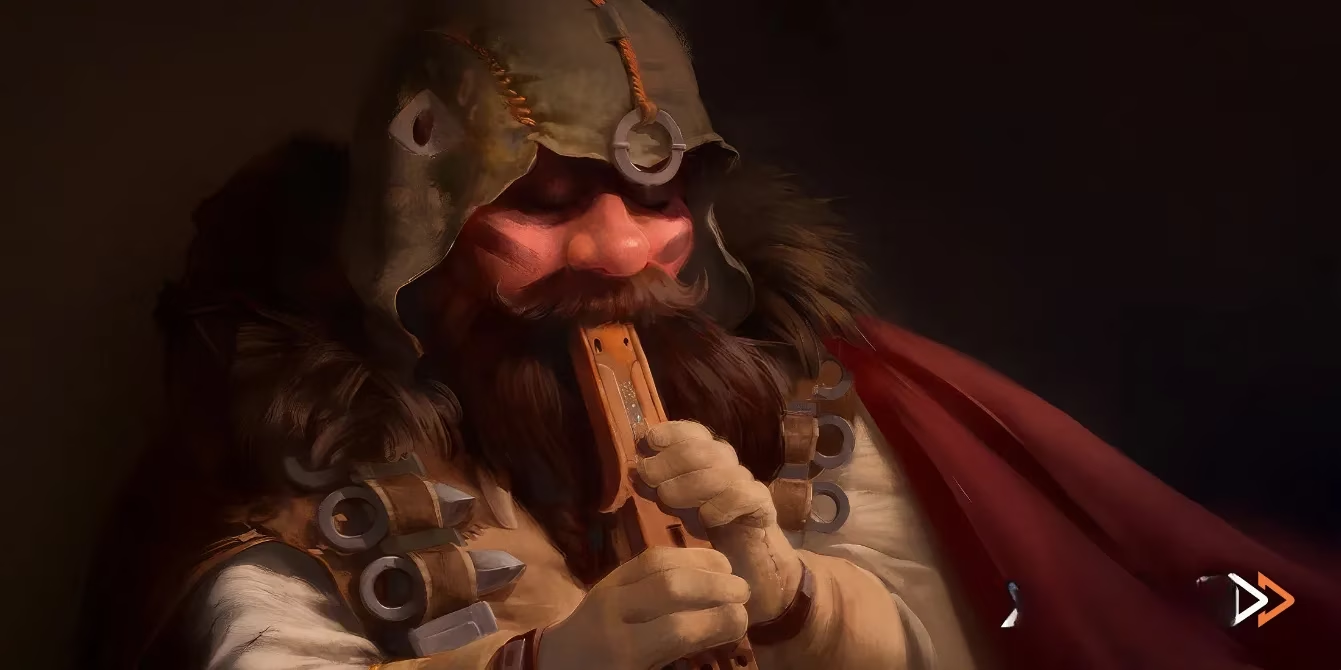
Marius first struck me as a lone thundercloud drifting over the Galawain’s Tusks — dark, self-contained, crackling with a kind of energy that warned you to keep your distance. He’s a survivalist who’d rather face a hurricane with nothing but a knife than endure a formal dinner party. As a Mountain Dwarf from Solace, a Pargrun Keep in a region most consider uninhabitable, he learned early that the wilderness doesn’t care about your comfort. That expertise made him invaluable, but it also built walls around him. His worldview was like an old map drawn in ink, seemingly fixed, but I soon saw the hidden, fading lines beneath — the connections he refused to acknowledge.
I sat down (virtually, of course) with Obsidian senior narrative designer Jay Turner to dig into Marius’s creation. “Marius is a loner for many reasons, some of which you’ll find out by spending time with him,” Turner told me. “But the saying is, ‘No man is an island,’ and that goes for Marius as well.” That phrase became the compass for everything Marius says and does. He may believe he is an island — a solitary cedar on a windswept ridge, gnarled and entirely self-sufficient — but his roots, you discover, are tangled invisibly with the entire Living Lands.
When the Envoy first recruits him, it’s not out of a desire for companionship. It’s pride. Marius prides himself on his ability to keep people alive in hostile territories, and acting as a guide offers him a role he can control. He doesn’t join because he wants friends; he joins because it validates his self-image as the ultimate protector. But even as he dryly comments on every dungeon we enter (“Don’t go down there, you’ll get yourself killed!”) and offers his outsider’s perspective on social situations where practical solutions trump diplomacy, something shifts. His voice, always a bit removed, slowly becomes the conscience of the group — the piece of the continent we didn’t know was missing.
Here’s how Marius evolves over the course of the journey:
-
The Island Phase: Distant, suspicious, quick to close himself off. He acts as a professional, not a friend. His dialogue is laced with survival-first logic, and he mocks any sentimentality.
-
The Archipelago Phase: Small cracks appear. He begins to value the party’s survival because he values the party. His dry humor gains warmth, and he shares hard-won pieces of his past.
-
The Continental Phase: He stops seeing himself as separate. “His people” become family. His skills are no longer just for survival — they’re for salvation. He becomes the living heartbeat of Donne’s poem, a man who truly understands he is part of the main.
Watching Marius open up felt like witnessing a glacier crack. It was slow, monumental, and entirely worth the wait. Every gruff retort he swallowed, every reluctant story he shared, peeled back layers of a person who had convinced himself he didn’t need anyone. By the end, I realized that Marius wasn’t just a guide through the Living Lands; he was a guide through the soul of the game itself.
The Living Lands setting, with its Dreamscourge twisting souls and soil alike, makes Marius’s arc essential. The plague doesn’t just harm bodies — it severs the connections between people, land, and spirit. In a world falling apart, Marius’s journey from isolation to integration becomes a counter-spell. His skills as a tracker, hunter, and survivor aren’t just gameplay mechanics; they’re the very threads he uses to stitch himself back into the fabric of the continent. He can’t cleanse the Dreamscourge alone. No island ever could.
I’ve played plenty of RPGs where companions start prickly and eventually warm up, but Marius’s transformation carries a philosophical weight I haven’t encountered before. The 17th-century metaphysical poets obsessed over conceits — extended metaphors that yanked seemingly disconnected ideas into harmony. Marius is that conceit. His personality is a river stone polished by years of isolation, yet his destiny is to be set in the great mosaic of the Living Lands, next to stones of every shape and color. He cannot be who he is without the continent, and the continent is weaker without him.
This isn’t subtext buried in lore books. Turner and the writing team made it explicit: every quest, every campfire conversation, nudges Marius toward the truth that Donne scribbled down in 1624. The poem hangs over the narrative like a familiar tune you can’t quite place, until suddenly you hear it loud and clear when Marius makes a crucial choice late in the game. It’s a testament to how video games can make poetry visceral — not by citing it, but by letting players live it.
For those stepping into Avowed in 2026, I have one piece of advice: don’t bench Marius thinking he’s just the grumpy wilderness expert. Bring him along. Listen to his complaints. And when he finally calls you family, you’ll understand why no island — not even one carved of dwarven granite — can stand apart from the main for long.