
How Change Defines Avowed's Story and Player Journey in 2026
Avowed review highlights Obsidian Entertainment’s masterful RPG, immersing players in the ever-changing world of Eora and the Living Lands.
When Avowed finally launched in February 2025, Obsidian Entertainment delivered exactly the kind of experience fans had been craving since its announcement half a decade earlier. Now, looking back from 2026, the game’s thematic ambitions stand out more than ever. Set in the already rich world of Eora, familiar to Pillars of Eternity veterans, Avowed pushes players to confront a single, relentless force: change. It shapes every quest, every relationship, and every painful decision, making the Living Lands feel less like a static map and more like a living argument about adaptation.
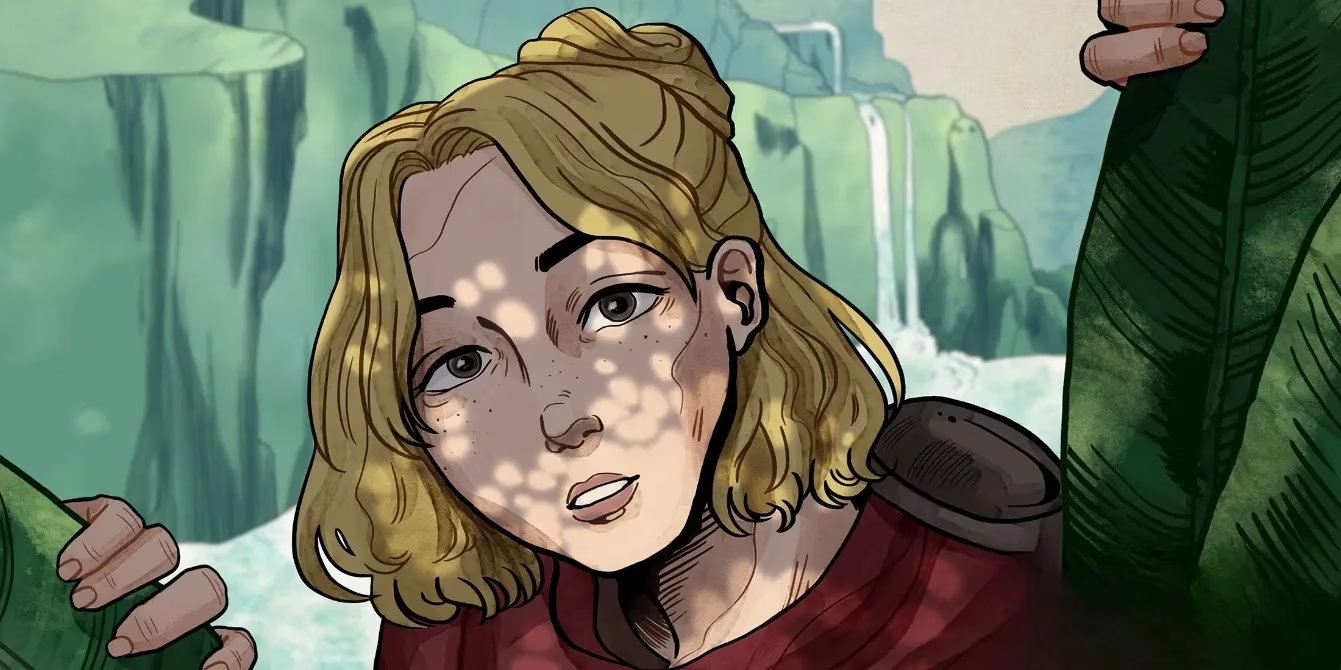
Players step into the worn boots of the Envoy, an agent of the Aedyran Empire trying to establish a foothold on a wild, untamed island. But the Living Lands refuses to be colonized quietly. The environment, the factions, and even the metaphysics of existence are in flux. Senior narrative designer Kate Dollarhyde once described the entire RPG as resting on the idea that “change is at the heart of Avowed.” That reveals itself not as a simple tagline but as a structural pillar. Between civil conflicts threatening to erupt back home, colonies yearning for independence, and the emergence of animancy—the science of souls—the world feels like a tide threatening to sweep everything away. Gods, who plan across centuries, are scrambling to secure relevance, and their anxiety trickles down into the mortal realm.
This constant upheaval manifests most dramatically through the Dreamscourge, a soul plague that distorts bodies and minds. It isn’t just a monster-spawning catastrophe; it’s a metaphysical crisis that forces everyone—Envoy included—to question identity and connection. The Living Lands wasn’t designed as a simple sandbox but as a philosophical question mark. As players venture deeper, they encounter three interwoven story strands: the plague’s spread, political scheming among crumbling empires and defiant colonists, and the personal arcs of companions who each struggle with their own transformations. These threads don’t run parallel; they tangle, forcing the Envoy to decide who to trust and what kind of future to work toward.
Obsidian’s narrative team clearly built every dialogue and conflict around that central theme of change. Throughout the game, characters voice variations on the same underlying fear: would we be stronger together, or does survival demand isolation? Can a person—or an island—grow into something new without losing what made it valuable? The Envoy’s choices become an answer written in action, and no one emerges untouched. The theme doesn’t merely sit in the background; it’s weaponized. Factions evolve based on player intervention, alliances crack under pressure, and the Envoy’s own godlike nature morphs depending on how the player interprets their inherited powers. That’s a far cry from the static heroism of older RPGs.
Gameplay reinforces this philosophy beautifully. Avowed doesn’t lock players into rigid class structures. Instead, it offers intermingling skill trees and an arsenal of distinct weapons, allowing the Envoy to adapt to challenges in real time. One moment a player might be sniping from a ledge with a bow, and the next they’re switching to a grimoire to unleash chaotic magic. This flexibility echoes the narrative: staying rigid means being consumed by the Dreamscourge, while adaptability offers at least a fighting chance. Obsidian’s design empowers the kind of personalization that turns a character from a preset hero into a reflection of the player’s own responses to impossible dilemmas.
Looking back from 2026, it’s also clear that Avowed benefited from not trying to be a sprawling, hundreds-of-hours epic. Its scope—roughly comparable to The Outer Worlds—means the weight of choices lands harder. There’s no filler region where decisions evaporate; every valley and settlement carries consequences. The shorter runtime concentrates the narrative, making the theme of change feel urgent rather than academic. Companions aren’t just skill bundles but people wrestling with their own evolutions, and their reactions to the Envoy’s decisions create some of the most memorable moments. When a loyal friend becomes a rival because of a principled stand, or when a faction leader transforms into a tyrant after a player’s subtle encouragement, the game’s thesis lands with emotional precision.
Even the physical design of the Living Lands mirrors the idea of restless adaptation. Jungles conceal shifting ruins, caves rearrange themselves with fungal blooms, and settlements look different on return visits. The island actively defends itself against those who try to claim it, a detail that smartly ties the environmental storytelling back to the anti-colonial undercurrent. The empires in decline—Aedyr, Vailia, Rauatai—represent the old order’s inability to change, while the Living Lands embodies the terrifying and hopeful potential of constant renewal. By placing the Envoy at the intersection of these forces, Avowed makes every player an explorer not just of geography but of moral metamorphosis.
All of this solidifies the game’s legacy a year after release. Avowed doesn’t hand out comfortable answers. It asks players to endure uncertainty alongside their Envoy, to accept that values are revealed most starkly under pressure. The choices crafted by Obsidian carry the gravitas required to make the theme of change feel like a lived experience rather than a writer’s conceit. For those still diving into the Living Lands in 2026, the journey remains a testament to how a well-executed central idea can transform a fantasy RPG into a mirror—one that reflects not just the character on screen, but the player’s own capacity to evolve.