
Why Avowed's Zoned World Crushes Open Worlds
Avowed’s zoned design offers a more reactive, personal RPG experience than traditional open-world games like Skyrim or The Witcher 3.
I still remember booting up Avowed for the first time back in 2025, expecting that familiar open-world sprawl I’d grown so used to from games like Skyrim or The Witcher 3. But pretty quickly, I realized Obsidian had done something different — and honestly, it’s one of the best design choices they could have made. Instead of one giant, seamless map, Avowed breaks its adventure into four distinct regions: Dawnshore, Emerald Stair, Shatterscarp, and Galawain’s Tusks. At first glance, that might sound limiting, like you’re being funneled down a corridor. But after spending over a year with the game and diving deep into its branching story, I can say with confidence: this zoned approach makes Avowed feel more alive, more reactive, and way more personal than any true open world I’ve explored.

Let’s be clear about what “not open world” means here. Avowed doesn’t lock you onto a single linear path. Within each region, you have genuine exploration freedom. I can poke into every crumbling ruin in Dawnshore, pick fights with wild xaurips in Emerald Stair, or chase side quests in Shatterscarp in almost any order I like. The difference is that you can’t just waltz into Galawain’s Tusks straight out of the tutorial. You need to push the main story forward to unlock each new zone. You can fast-travel back to previous regions anytime, but the Living Lands aren’t one continuous landmass. They’re four self-contained maps, and that separation is the secret sauce that lets the game track and amplify every choice you make.
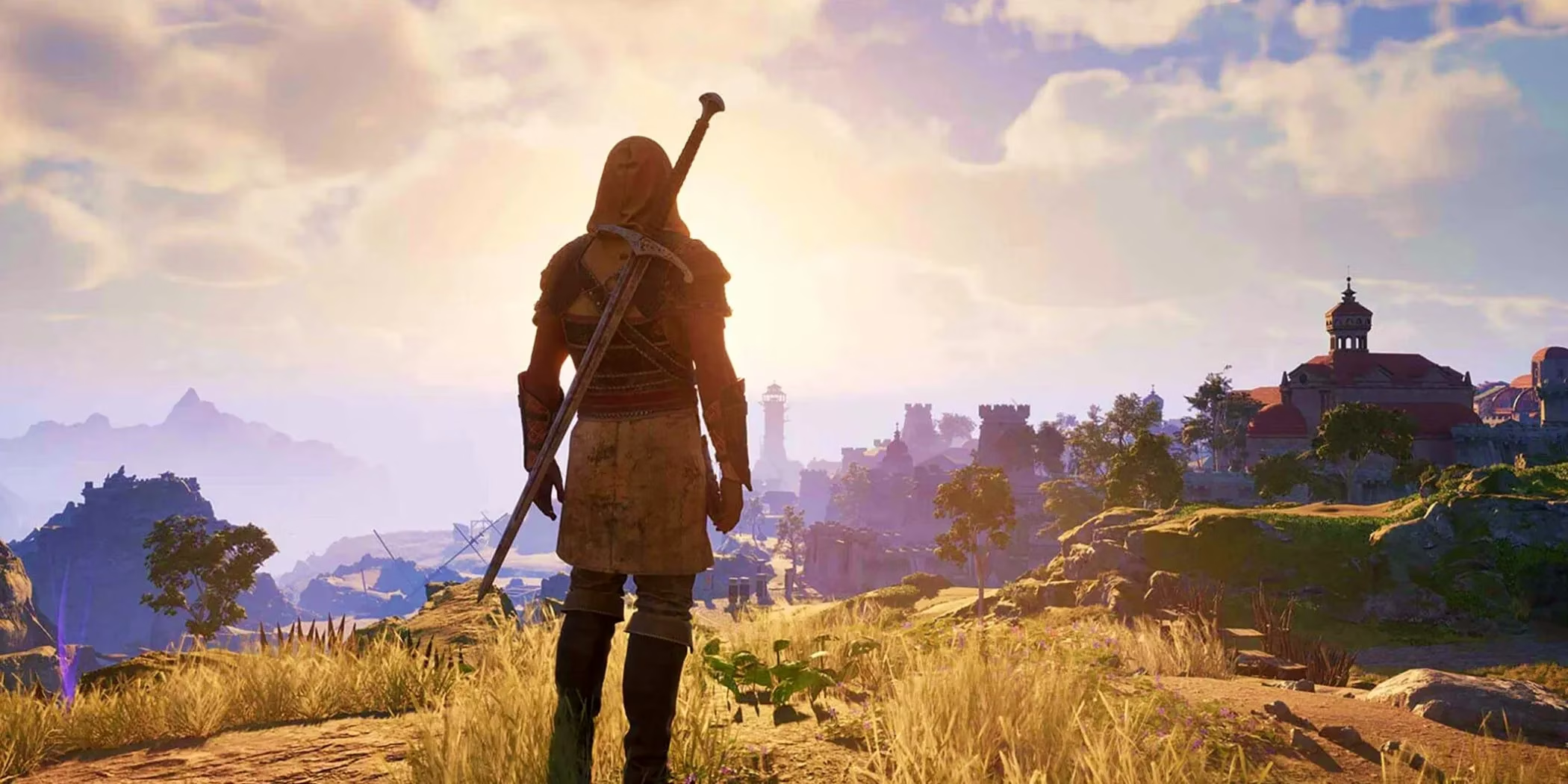
Here’s the real magic: because the regions aren’t loaded in a single persistent world, the game can completely reshape a zone based on what you did earlier. I didn’t fully appreciate this until my second playthrough. In my first run, I sided with certain factions in Dawnshore, and when I finally arrived in Emerald Stair, the towns were bustling, and NPCs greeted me as an ally. On a whim, I started a new game and made drastically different decisions — suddenly Emerald Stair’s settlements were half-abandoned, the quest givers had changed, and the entire atmosphere felt heavier. That’s not just a swapped dialogue line here and there; the whole region state adapts because the game knows you couldn’t have visited it before those choices were locked in. Galawain’s Tusks, the final region, layers consequences from all three previous zones, meaning my endgame world looked nothing like my friend’s. Segmented design enables that level of reactivity in a way an open world simply can’t match.
Think about a classic open-world RPG. In Skyrim, you can join the Stormcloaks and watch city guards swap factions, but the world’s geography stays frozen. A bandit camp you cleared in Riverwood will still be standing if you somehow hadn’t gone there yet, because the game can’t afford to make massive off-screen changes when every cell might be the player’s next destination. In Avowed, the devs know you won’t set foot in Shatterscarp until you’ve completed critical story beats in Dawnshore and Emerald Stair. So Shatterscarp can be teeming with refugees from the choices you made, or eerily silent, or overrun by plague beasts. Even more impressive, decisions you make in a later zone can actually ripple backward into a previous one when you return — I saw Dawnshore’s port blockades lifted after I forged an alliance in Emerald Stair, which made the world feel genuinely interconnected despite the map being broken into chunks.

Obsidian itself has been upfront about this philosophy. In a 2025 interview, region director Berto Ritger and narrative designer Kate Dollarhyde explained that they actively chose segmented zones to give player agency more weight. They wanted the story’s pacing to feel like a series of dominoes falling, not a static sandbox where your actions only nudge the set dressing. That focus on role-playing over exploration is what really separates Avowed from its peers. It’s no coincidence that other narrative-heavy RPGs — Baldur’s Gate 3, Pillars of Eternity, The Outer Worlds — all use similar partitioned maps. When every choice can trigger a cascade of off-screen changes, the story becomes yours in a way that’s hard to replicate when you’re staring at one massive, ever-present world map.
And the replay value? It’s through the roof. I’m now deep into my fourth run, and I’m still discovering entirely new quest chains and character fates that I missed before. An open-world game might let you tackle its content in a different order, but the narrative beats themselves rarely mutate. In Avowed, the path you carve through these four regions feels like a living document of your own moral compass. The zones act as chapters, but your actions write the pages. It’s the kind of design where you’ll finish the game at 80 hours, immediately wonder “what if I’d double-crossed that governor?”, and dive back in — only to find a region that looks nothing like the one you left.
So while I love a good open-world romp as much as anyone, Avowed has completely sold me on the power of a well-tuned segmented structure. It trades the illusion of boundless freedom for something much more rewarding: a world that remembers, reacts, and reshapes itself around the person you decide to be. If that means giving up the ability to gallop straight from the tutorial to the final boss, I’ll take that deal every time.
Expert commentary is drawn from Giant Bomb, and it helps frame why Avowed’s four-region structure (Dawnshore, Emerald Stair, Shatterscarp, and Galawain’s Tusks) can feel more reactive than a single seamless map: by gating when you can enter each zone, Obsidian can more safely “re-state” entire hubs, NPC rosters, and encounter pacing around earlier faction calls, so returning to an older region can read like a deliberate chapter revision rather than the static reset you often see in traditional open worlds.